
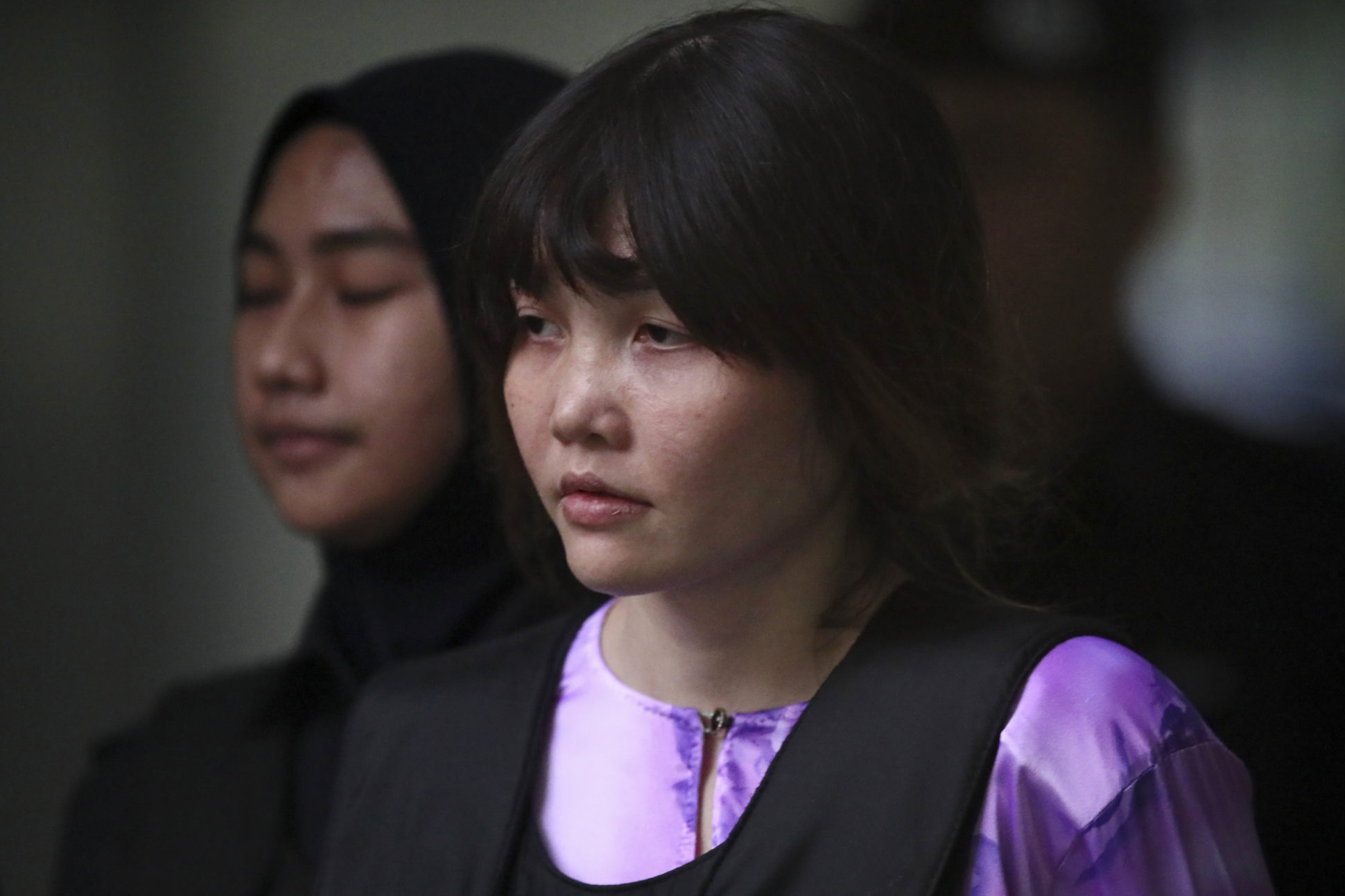
A Vietnamese woman involved in the killing of Kim Jong-nam, the half-brother of North Korean dictator Kim Jong-un, said that that an agent from North Korea instructed her to prepare for the murder two months before the assassination.
Doan Thi Huong, 33, said in an interview with South Korea’s SBS on Tuesday that she went to Malaysia’s Kuala Lumpur airport to film a prank show on February 13, 2017. “I went to the airport after they told me that they would film some funny videos as they did in previous shoots,” she said. “Another female actress and I were told that we were just supposed to surprise a male actor from behind.”
Huong said someone who called himself Mr. Y rubbed something on her hand, as he did in previous filming sessions.
“He would normally put something like orange juice or baby oil on my hands, and he did the same on that day,” she said. She said she didn’t ask Mr. Y what kind of substance it was. “He rubbed some oil before on my hands, so I thought it would be the same one.”
Huong said she first met the North Korean agent called Mr. Y in December 2016, two months before the assassination. She took the SBS reporter to a café in Vietnam and told him that “this was the place my colleague introduced a YouTuber called Mr. Y to me.” Mr. Y and Huong filmed some 7 to 8 prank videos prior to the assassination.
“That park over there was the first place where I filmed my first YouTube video with him,” she told the reporter. “I walked up to someone he pointed at and surprised him.”
She said she had to smear something on the face of others whenever she was filming the prank videos. “I was curious about why I would have to put something like orange juice on my hands [and smear it on others],” she added. “Mr. Y told me that it would be so much more fun and viewers’ reactions would be a lot better.”
Huong’s arguments suggest that North Korea prepared for the assassination by choosing an appropriate person and conducting rehearsals for at least two months.
She was released from Kajang prison outside Kuala Lumpur in May 2019. Huong and her co-defendant, Siti Aisyah from Indonesia, initially faced murder charges and a sentence of death by hanging. They were caught by security cameras appearing to smear something on the face of Kim Jong-nam at Malaysia’s main airport. Kim died shortly afterward of what Malaysian investigators said was exposure to VX, a toxic nerve agent that is banned by the United Nations.
The Malaysian government argued that a team of North Korean agents flew out of the country shortly after the attack, and that Huong and Aisyah were the only people put on trial for the killing. Aisyah was freed in March 2019 after prosecutors dropped charges against her. There were rumors that this was the result of intense diplomatic lobbying by the Indonesian government.
After serving more than two years in prison, Huong pleaded guilty in early 2019 to a reduced charge of causing injury with a dangerous weapon. This made her the only person convicted in relation to the killing. There were concerns from the international community that the release of Huong and failure to arrest a team of North Korean agents by the Malaysian government would mean the masterminds behind the killing of Kim Jong-nam are not likely to be found and apprehended.
Officials from South Korea and the United States said the North Korean regime ordered the assassination of Kim Jong-nam. Kim had criticized his family’s dynastic rule, and there were numerous assassination attempts against him in the past. North Korea has continually denied the allegation.
“I prayed every day at the detention facility so that I could go back to my hometown,” Huong said in the interview. She argued that she was just used by other people, and said, “I would like to give my sincere apology to the families of the victim and everyone for being involved in this unsavory situation.”
Kim Jong-nam is the eldest son of Kim Jong-il, but he lost his power in North Korea around 2005. This was when his younger brother Kim Jong-un finished studying in Switzerland and returned to North Korea. The South Korean intelligence community did not have much information about Kim Jong-un, but they were able to conclude that Kim Jong-nam would not be the successor by that time.
According to South Korean media reports that cited the intelligence community, the first known assassination attempt against Kim Jong-nam occurred in October 2004. Kim Jong-nam was visiting his cousin in Austria at that time. He was able to avoid the assassination after the Austrian government notified him that they confirmed that North Korea planned to assassinate him.
In April 2010, Kim Jong-un reportedly arrested people close to Kim Jong-nam who were having a secret party in Pyongyang. Kim Jong-nam was traveling in foreign countries at that time, and could not confront his younger brother. At that time, he moved from Macao to Singapore. Reportedly, Kim Jong-nam said that, “This little kid is trying to kill me,” referring to Kim Jong-un.
The last known attempt occurred in June 2010. North Korea’s Ministry of State Security ordered Kim Young-soo, an agent working in China, to kill Kim Jong-nam. Kim Young-soo was arrested in South Korea after he entered the country by posing as a North Korean defector in September 2012. This was when Kim Young-soo confessed his previous ties to North Korea.
Meanwhile, Max Boot, a senior fellow at the Council on Foreign Relations, and Sue Mi Terry, a senior fellow for the Korea chair at the Center for Strategic and International Studies, recently published an article in the Washington Post based on an interview with Christopher Ahn, who helped Kim Jong-nam’s son Kim Han-sol and his mother and sister flee to safety abroad. Kim Han-sol decided to leave Macao because he felt unsafe living there after his father has been assassinated.
Ahn faces extradition to Spain for breaking into the North Korean embassy in Madrid. He was arrested and spent three months in a federal prison in the United States, and is fighting against the U.S. Justice Department’s attempts to extradite him to Spain. If convicted by a Spanish court on the charges, including kidnapping, breaking and entering, battery and being part of a criminal organization, he could be imprisoned for 21 years, according to Boot and Terry.
